
A job description can stay untouched for years while the job it describes changes considerably.
That happens easily in a growing business. Responsibilities move between people, managers hand over work, new systems remove some tasks and create others, and people gradually take ownership of things that were never part of the original role. When the business next recruits into that position, it can be tempting to open the existing document, make a few edits and use it again.
The risk is that the business ends up recruiting for the role it used to have rather than the one it now needs.
A useful job description template UK employers can work from should therefore do more than provide headings for responsibilities and reporting lines. It should help the business describe why the role exists, what it is accountable for, how it contributes to the wider organisation and what someone needs to do the job well.
CIPD’s ‘Job design’ factsheet (published 23 July 2025) describes job design, also referred to as work design, as the process of establishing employees’ roles and responsibilities. Its purpose includes creating value and supporting performance while contributing to good-quality work.
For an SME, that is a useful starting point because the document should follow the thinking about the role, rather than replace it.
The guidance and sources referenced in this article reflect the position as at 14 September 2026.
How do you write a job description for the role you need now?
Before writing the job description itself, it helps to establish what the business actually needs from the role.
That means looking beyond the person currently doing the job and considering the work in its current context. The responsibilities may have changed since the role was created, parts of the work may now sit elsewhere, and the business may expect a different level of judgement or accountability from whoever holds the position next.
A sensible starting point is to establish the purpose of the role, the results it is responsible for, the decisions that sit within it, the people or functions it works closely with, and the knowledge or experience someone genuinely needs in order to succeed.
CIPD’s ‘Job design’ factsheet (published 23 July 2025) distinguishes job design from job analysis. Job design concerns how roles and responsibilities are established, while job analysis helps an organisation understand the work and the requirements attached to it.
That distinction is useful because an old job description is evidence of how a role was previously defined. It is not necessarily evidence of what the job now requires.
Case study: Firstsource redesigned its HR model around changing business needs
Firstsource provides a useful example of roles being reconsidered as part of wider organisational change.
In 2023, the organisation was restructuring its HR function while also trying to strengthen its talent pipeline and capability. Rather than simply retaining the existing model, it reviewed how the function needed to operate and developed its capability around the changing requirements of the business. CIPD’s case study ‘Transforming the HR operating model: Firstsource’ (published 5 June 2024) describes the work as a transformation of the HR operating model intended to align the function more closely with those needs.
The scale of Firstsource is very different from that of most JourneyHR clients, but the underlying question is relevant to any growing organisation: when the business changes, do the roles still reflect the work that needs to be done?
For a smaller company, answering that may only require reviewing a handful of positions. The principle remains the same. The role should be designed around the current requirement rather than inherited automatically from a previous structure.
In our work with growing businesses, we often find that this question leads quickly from “does the job description need updating?” to “is the role itself still designed in the right way?” We would look at the current accountabilities first, before rewriting the document around them.
What should a UK job description include?
There is no single format that every UK employer has to use for a job description.
Acas provides free templates containing the main headings, the role's principal duties and the reporting relationship.
Those sources give employers a useful framework, but the quality of the document still depends on the thinking behind each section.
Where a business needs support turning that thinking into a clear, current role profile, our Job Descriptions service focuses on defining responsibilities, requirements and success measures around the role the organisation actually needs.
Job title
The title should give someone a reasonably accurate understanding of the level and nature of the role.
Internal titles do not have to copy terminology used elsewhere in the market, but a title that bears little relationship to the work can make recruitment harder and create confusion internally about seniority or responsibility.
Role purpose
The purpose should explain why the job exists and what contribution the organisation expects from it.
This is different from listing everything the person does. A useful role-purpose statement gives the reader enough context to understand the reason for the position before moving into the detail.
Example
This role is responsible for the day-to-day management of the company's finance operations and for giving the leadership team accurate financial information to support commercial decisions.
That tells the reader more about the role than a broad statement such as 'responsible for all aspects of finance'.
Reporting line and team structure
The document should make clear which role the employee reports to and whether they have responsibility for other people.
In a growing organisation, this can help expose questions that need resolving before recruitment begins. If two senior roles appear to own the same area, or if nobody is clearly accountable for a decision, that is a structural issue rather than a wording issue.
Key responsibilities
A useful job responsibilities template should describe areas of ownership clearly enough for both the employee and manager to understand what sits within the role.
It does not need to catalogue every routine activity or anticipate every task a postholder may be asked to perform.
A responsibility such as 'prepare monthly sales reports' describes an activity. By contrast, 'own sales performance reporting so that the leadership team has an accurate view of pipeline, conversion and forecast performance' gives more information about the accountability attached to that activity.
That does not mean every responsibility has to be written as an outcome statement. It means the reader should be able to understand what the person is responsible for rather than simply seeing a long inventory of tasks.
Skills, knowledge and experience
This section should distinguish between what someone genuinely needs in order to do the work and what would merely be useful.
Business.gov.uk advises employers to define the role and ideal candidate before advertising, including the tasks involved and the skills or experience required. It also states that criteria in the person specification should be relevant to the job.
That matters because requirements can accumulate over time. An old job description may contain qualifications, years of experience or sector knowledge that were once considered necessary but no longer reflect how the work is done.
Reviewing those requirements before every recruitment exercise helps make sure the organisation is selecting against the job it actually has.
Measures of success
Some employers include measures of success within the job description or role profile, while others keep them within objectives or performance documents.
Either approach can work. Where measures are included, they should help clarify what successful performance looks like without turning the job description into a rigid scorecard. The appropriate measures will depend on the role and could include service standards, commercial outcomes, project delivery, quality, team performance or other clearly defined results.
The important point is to avoid implying that one format is mandatory. It is not.
What is the difference between a job description and a role profile?
There is no universally applied distinction between these terms, so employers should define and use them consistently within their own organisation.
A job description often concentrates on the purpose of the role, responsibilities, reporting arrangements and requirements. A role profile may cover those areas while also including broader information such as capabilities, behaviours, decision-making authority, expected outcomes or career level.
The terminology matters less than the usefulness of the document. What should be avoided is assuming that a different label automatically produces a better description of the work. A role profile template UK employers adopt will still become outdated if nobody reviews it when responsibilities or organisational needs change.
Case study: WCVA linked competencies with organisational change
The Welsh Council for Voluntary Action provides a useful example of role clarity sitting within a wider organisational framework.
Following an organisation-wide restructure, WCVA introduced a new competency framework and redesigned its pay and grading structure. CIPD’s case study ‘Change management journey: WCVA’ (published 20 August 2026) describes how employees were involved throughout the process and how the organisation adapted its approach as the work progressed.
The example is relevant because roles rarely exist independently of pay, progression and organisational structure.
If employees cannot see the difference between one level and the next, promotion conversations become difficult. If responsibilities have expanded substantially but the role documentation has not changed, questions around grading or salary can become harder to resolve. If several roles describe overlapping accountability, managers can end up making inconsistent decisions about ownership.
Updating a job description may therefore solve the immediate documentation problem, but sometimes the review reveals a wider issue with structure, progression or accountability that also needs attention.
We see this frequently: a job-description review starts as a documentation exercise and exposes a wider question about levels, progression or ownership. At that point, we would usually test the role against the surrounding structure rather than treating the wording in isolation.
How detailed should a job description be?
A good job description should contain enough detail for someone to understand what the role is there to achieve without trying to anticipate every activity that may arise.
Keep job descriptions clear and succinct. If a role combines too many unrelated or high-level activities, it may be a sign that the position itself has become overloaded.
That is an important distinction because a long job description may be badly written, but it can also be accurately describing a badly designed job.
A growing business can gradually add responsibilities to a capable employee because that person is trusted to take them on. Over time, the role may end up combining work that would sit more logically across two positions or functions.
In that situation, shortening the document does not resolve the problem. The business needs to decide whether the responsibilities still belong together.
When should you review an existing job description?
There is no single review timetable that will be right for every organisation.
The more useful approach is to review a job description when something changes that affects the substance of the role.
Recruitment is an obvious point to do it because the organisation is about to make a decision based on the description. A restructure, a change in reporting lines, the introduction of new technology, a significant shift in responsibilities or the creation of a new career level can all be sensible triggers as well.
Business.gov.uk recommends defining the role and candidate requirements before recruitment, rather than moving directly into advertising.
That gives the organisation an opportunity to ask whether the existing document still matches the job before it is reused.
Case study: FinanceCo reviewed how AI was changing software-development work
Technology is making this question more immediate for some employers.
CIPD and the Institute for the Future of Work’s case study ‘How a bank supported AI-enabled software developer performance through collaborative job design’ (published April 2026) examined a UK bank, referred to as FinanceCo, as it introduced an AI coding assistant for software developers.
The research found that some aspects of developers' work were changing. Greater use of AI could shift attention away from writing code manually and towards work such as evaluating code quality, understanding wider system architecture, peer review and problem solving. The case study's recommendations included updating job and role descriptions to reflect current work and retaining enough flexibility for roles to develop as technical requirements changed.
The useful point for employers is not that every role needs rewriting because of AI. It is that a material change in how work is performed should prompt a review of whether the documented role still reflects reality.
Without that review, recruitment criteria, performance expectations and development plans can gradually become disconnected from the work employees are actually doing.
When we work through this with clients, we would not start by rewriting every role affected by new technology. We would first identify where the work, decision-making or skill requirement has materially changed, then update the roles where that change is real.
What should employers check before reusing an old job description?
Before using an existing document for recruitment or performance purposes, review the role against its current context.
Start with its purpose. If the reason the job exists has changed, the rest of the document probably needs more than minor edits.
Then look at the responsibilities and where they now sit across the organisation. Work may have moved to another team, been automated, expanded in scope or become more senior.
The requirements also deserve a fresh review. Qualifications and experience should still relate to the current job rather than simply remaining because they appeared in the previous version.
Finally, consider whether the role makes sense within the surrounding structure. A job description cannot resolve unclear accountability if the leadership team has not decided where that accountability belongs.
This is one of the reasons reviewing roles can be commercially useful. The process often identifies an organisational question that would otherwise remain hidden inside a document.
A practical job description format for employers
A template can give the process structure, provided the organisation treats it as a starting point rather than the answer.
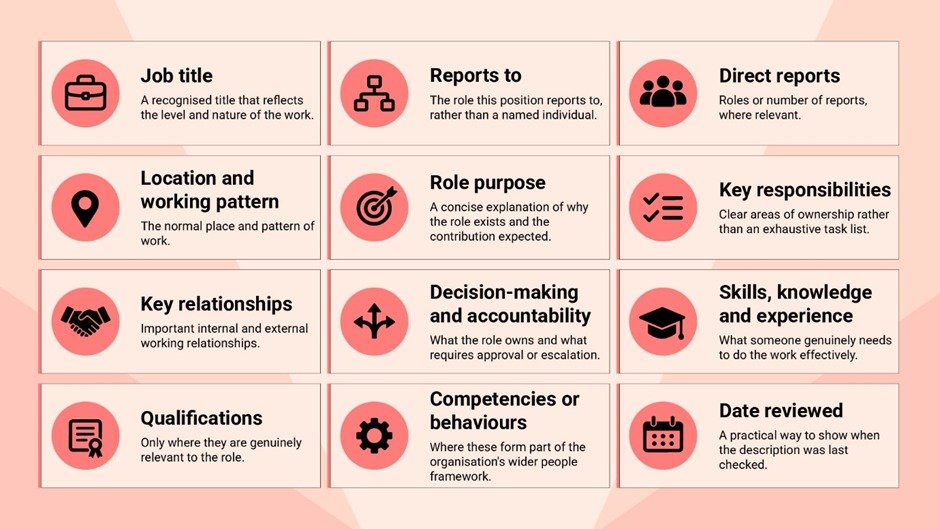
Some organisations will also include expected outcomes, competencies or behaviours where those form part of their wider people framework.
Acas provides downloadable job description templates for employers, including an outline version and examples.
The most useful template is therefore not necessarily the longest one. It is the one that creates enough consistency across the organisation while leaving room to describe each role accurately.
We also find that role documentation works best when it is consistent with the policies and people processes around it. Our HR Policy + Process Consultancy helps businesses align job descriptions, onboarding, performance processes and wider HR documentation so that expectations are clear across the employee journey.
Why does job design matter beyond recruitment?
Job descriptions are often associated with hiring because that is when employers are most likely to need one quickly.
Their usefulness can extend beyond recruitment, supporting induction, performance management and objective setting.
In a growing business, role clarity can also affect delegation, management, progression and organisational design.
If an employee and their manager have different assumptions about what the employee owns, a performance conversation can quickly become difficult. If nobody can explain how one career level differs from the next, progression decisions become harder to defend consistently. If two functions both believe they own the same decision, work can be duplicated or delayed.
Those problems cannot all be solved by writing better job descriptions, but reviewing role design can make them visible early enough for the organisation to address the underlying issue.
Where the issue is really about duplicated accountability, reporting lines or how responsibilities sit across teams, our Organisational Design service looks at role clarity and structure together, rather than trying to solve a structural problem through wording alone.
How JourneyHR can help
We work with growing businesses on role design, job descriptions, organisational structures, competency frameworks, career pathways and the wider People + Culture questions that sit around them.
Sometimes the requirement is contained. A business is recruiting and needs several outdated job descriptions reviewed so that they reflect the current roles.
In other situations, the documents reveal something broader. Responsibilities overlap, levels have developed inconsistently, employees cannot see how progression works, or managers have different interpretations of where accountability sits.
In those cases, rewriting the wording alone is unlikely to be enough. The more useful work may involve looking at the structure, career levels, competencies and role boundaries together before documenting them.
The aim is to give the business, managers and employees a clearer shared understanding of what each role is there to do.
Get in touch: journeyhr.com
Final thought
A template can help an employer organise a job description, but it cannot decide what the role should be.
That decision comes first. When responsibilities, technology or organisational structures change, the description needs to be reconsidered against the work as it exists now. Otherwise, the document can remain tidy while becoming increasingly disconnected from the job.
For growing businesses, the value is in making that gap visible before it starts affecting recruitment, performance or progression.
FAQs
What should a UK job description include?
A typical UK job description can include the job title, purpose of the role, principal responsibilities, reporting line, working hours, location and relevant employment information. Employers may also include skills, experience, competencies or expected outcomes where these help explain the role. Acas provides free templates.
How do you write a job description?
Start by defining the work rather than copying an old document. Establish why the role exists, what it is responsible for, where it sits within the organisation and what someone genuinely needs to perform it. Once those points are clear, the job description can record them in a consistent format. Business.gov.uk similarly recommends defining the role and required skills or experience before recruitment begins.
What is the difference between a job description and a role profile?
There is no universally fixed distinction. A job description commonly focuses on the role's purpose, responsibilities and reporting arrangements, while some organisations use a role profile to include broader information such as capabilities, behaviours, decision-making authority or career level. Employers should choose terminology that suits their organisation and use it consistently.
How often should a job description be reviewed?
There is no single review interval that every UK employer needs to follow. Review is particularly useful when recruiting into the role, changing organisational structure, moving significant responsibilities, introducing technology that changes the work, or altering reporting relationships. The purpose is to confirm that the document still describes the job being performed or recruited for.
Can an employer reuse an old job description when replacing someone?
Yes, as a starting point, but it is sensible to check whether the role has changed before using it again. Responsibilities may have moved, technology may have altered the work, or the skills needed may now be different. Business.gov.uk recommends clarifying the role, tasks and candidate requirements before advertising a vacancy.
