
Where will learning make the biggest difference to your business? A learning needs analysis helps you work that out by looking at what your people need to be able to do now and in the future, where the gaps are, and which of those gaps learning can genuinely help to close. It starts with the business problem, not a list of courses, and brings together evidence from performance, managers, employees, roles and future plans before you spend money on training.
It's a familiar situation in a growing business. Someone suggests more training for managers, a budget is agreed and a course is booked. Everyone hopes it will help.
Sometimes it does. Other times, a good course makes less difference than everyone hoped, because the business hasn't yet had the chance to explore what really needs to change.
That's where a learning needs analysis can help.
CIPD's Learning Needs Analysis factsheet (published 20 August 2025) describes learning needs analysis as an ongoing process of gathering data about employees' capabilities and the skills an organisation requires, including the implications of new and changing roles. It should flow from business strategy and help ensure that the organisation has enough capability to sustain current and future performance.
This article offers general HR guidance, rather than legal advice on a particular situation. References to employment-law duties relate to Great Britain; different rules may apply elsewhere, including Northern Ireland. External guidance can change, so check the source and seek advice before making a decision about your own circumstances.
In a small business, every learning investment needs to work hard. Budgets are tighter, people often cover broader roles, and taking six managers away from client work for a day has a real cost. When you have 40 or 80 people rather than 4,000, a programme that misses the mark can make a noticeable dent in both the budget and the team's time.
Before asking, 'What training should we provide?', it helps to take a step back. What does your business need people to be able to do? What can they do now? Where's the gap, and what's behind it? Those are the questions we'd start with.
What is a learning needs analysis?
A learning needs analysis, usually shortened to LNA, compares the capabilities your business needs with the capabilities it has today. In other words, it helps you understand what your people need to know and be able to do, and where they may need support.
That means looking beyond skills and knowledge alone. Behaviours, confidence, management capability and judgement can all be part of the picture, particularly when someone's role is changing.
The CIPD recommends looking at needs at three connected levels: the organisation as a whole, particular teams or projects, and individual employees. Looking at only one level can give a distorted picture.
Imagine a 70-person business where the starting point is, 'Our managers need performance management training.' That may be part of the answer. But a closer look might show that managers understand the process and need clearer expectations of good performance in each role. Perhaps job descriptions haven't been updated for three years, senior leaders aren't consistently backing difficult decisions, or managers have 12 direct reports and too little time to support them. Each points to a different kind of help.
Training may help with some of this, but it can't resolve every part of the picture on its own.
For us, that's one of the most useful things an LNA can reveal. It helps you decide not just what people could learn, but whether learning is the right response. CIPD makes the same point: once you've identified a performance gap, explore the different ways to address it rather than automatically booking a course.
What is the difference between learning needs analysis and training needs analysis?
You'll often hear 'learning needs analysis' and 'training needs analysis' used together. The main distinction is how widely you look and whether you're reviewing needs over time or for a particular activity.
A training needs analysis, or TNA, traditionally focuses on a particular training activity. It helps you understand what training a person or team needs for that purpose.
A learning needs analysis takes a wider view: what capabilities does the business need, where are the gaps, what's causing them, and what's the best way to close them?
The CIPD describes an LNA as an ongoing health check on organisational skills, talent and capability, while a TNA is more likely to be a one-off exercise connected with a particular training requirement.
Here's how that can play out. A manager says, 'My team needs time management training.' Before choosing a programme, it's worth exploring what's making time difficult to manage, whatever you call the analysis. Perhaps work is being duplicated because decision-making responsibilities aren't clear, meetings have grown to fill the week, or priorities change every 48 hours. A broader LNA helps bring those organisational factors into the conversation.
The CIPD has discussed exactly this problem in its evidence-based learning and development work: organisations can ask for one type of training when further questioning reveals that the underlying performance issue requires something quite different.
For a small business, taking that step back can save valuable time and help you choose support that fits.
How do you run a learning needs analysis for a small business?
You can keep this manageable. For most small and medium-sized businesses, a focused review that you revisit regularly is more useful than a lengthy exercise or a spreadsheet that's difficult to maintain. We'd start with the questions that matter most to your business and build from there.
These six questions give you a practical starting point:
What is the business trying to achieve over the next 12 to 24 months?
What will people need to do differently for that to happen?
Which capabilities will matter most?
What evidence do we have about current capability?
Where are the important gaps?
Which gaps should be addressed through learning, and which require another response?
Working through them in this order helps you understand the need before looking for a course.
Start with the business plan, not the training plan
Start with what's already on your leadership team's agenda. You don't need a separate learning plan before you can begin.
Perhaps you're moving into a new market, sharing management responsibility more widely, introducing AI tools or growing your sales team. You might be working to reduce errors, retain more clients or prepare a new group of directors. Each priority raises different questions about what your people need to learn.
If you're planning to double headcount, for example, first-line managers may need more support. If you're moving decisions away from the founders in a professional services business, commercial judgement, delegation and leadership may become more important. And when you're introducing technology, technical training may be only part of the answer: managers may also need to rethink responsibilities, agree quality controls and help people adjust to a different way of working.
CIPD connects learning needs with business strategy, current performance and future capability. It's a helpful reminder that an LNA is part of running the business well, with HR and leaders working together, rather than a separate HR exercise.
Define what good performance actually looks like
It helps to agree what good looks like before asking where someone's skills need developing. Without that shared starting point, people can be working towards quite different expectations.
When a founder says, 'We need stronger managers,' that's a useful place to begin. The next question is: what would those managers be doing differently day to day?
In one business, the priority might be setting clear expectations, giving feedback early and making sound decisions without always referring back to directors. In another, it could be coaching technical specialists, managing budgets or handling difficult client conversations. Being specific helps you find the right support for each group.
CIPD recommends looking at the capabilities each role needs, those already in place and the gap between current and future needs. Competency or career frameworks can help make that clearer. If the underlying issue is unclear roles, responsibilities or structure, Organisational Design work may be part of the answer alongside, or before, learning.
You don't need a large formal framework to get started. For each important role or group, agree:
what people need to know;
what they need to be able to do;
what good performance looks like in practice;
which capabilities are likely to become more important over the next year.
That gives everyone a clearer, shared basis for the conversation.
What data should a training needs analysis use?
Asking employees, 'What training would you like?' can open up a useful conversation. The difficulty comes when those answers become the whole analysis: a list of course requests may not show what the business needs or what's making the work harder than it needs to be.
People's own experiences matter. They can tell you where they feel uncertain and where they'd like to develop. Bring that insight together with other evidence, so you're not asking a survey to tell the whole story.
The most useful picture comes from bringing several types of evidence together.
The CIPD recommends drawing on organisational data, stakeholder interviews, informal conversations, team meetings, observations, surveys, learning-system data, competency frameworks, performance-management information and documents such as business plans and role descriptions. It specifically advises combining methods rather than relying on a single source.
A quick word on privacy: use only the personal information you genuinely need, explain to employees how it will be used, restrict access and keep it only for as long as necessary. Identify an appropriate lawful basis before using employee records. If information reveals someone's health, an additional special-category condition is needed too. Look for team-level patterns where possible, and remember that people may still be identifiable in a small team even when names are removed.
For a smaller business, we'd bring that evidence together in four areas.
Business performance data
Look first at what's happening in the business. Depending on your priorities, useful indicators might include:
sales conversion;
customer complaints;
quality errors;
missed deadlines;
client retention;
absence;
employee turnover;
probation outcomes;
grievances;
performance ratings;
productivity;
promotion readiness.
If customer complaints have increased, for example, that's a reason to explore, not a diagnosis in itself. Is the issue knowledge, communication, staffing levels or a new system? Are service standards realistic, and do people have the supervision they need? Understanding the context helps you decide whether learning will make a difference.
Manager insight
Managers can bring valuable insight into where their teams need support. Rather than starting with a request for training, invite them to talk about the work itself.
You might ask: where does good performance feel harder to achieve than it should? Are there conversations managers would welcome help with? What do people regularly ask for support on? And what will the team need to do in six months that it can't yet do consistently?
Those questions help you move from a course request to a clearer understanding of the support needed.
Employee evidence
Make room for employees to share their experience too. The aim is to understand what helps them do their best work, where they're getting stuck and how they'd like to grow.
Alongside asking about courses, talk about the tasks people find unnecessarily difficult and where they'd welcome more confidence or support. Explore responsibilities they may take on next, skills they'd like to build for progression, barriers to doing the job well, and any processes or expectations that aren't clear.
If leaders and employees see the needs differently, that's worth exploring together. It can help you understand a part of the working day that isn't visible from the leadership meeting.
Role and future-work data
Leave some space to look ahead. A useful LNA helps you prepare for changes in the work, as well as supporting people with today's challenges.
Which roles are getting broader? What work might automation remove? Is there a critical activity that only one senior employee knows how to do? And what capabilities might you need at 100 people that you don't yet need at 60?
That's why we find an ongoing learning needs analysis more useful than an annual training questionnaire alone. It helps you support people in the business you have today while preparing them for the business you're becoming.
How do you identify skills gaps across a team?
Start with the work your team needs to deliver, rather than a long list of generic competencies. That makes it easier to focus on the skills that will make a difference.
Agree the capabilities needed for the team's most important outcomes, then look together at the evidence of how consistently people can put them into practice today.
Make the assessment a conversation, not just a rating exercise. Explain the criteria and invite people to share evidence and talk about barriers or unequal access to development. In Great Britain, employers must make reasonable adjustments where the legal duty applies to a disabled employee. That can include changes to an assessment or how training is delivered. A need for an adjustment isn't, by itself, a skills gap.
You might use a simple scale:
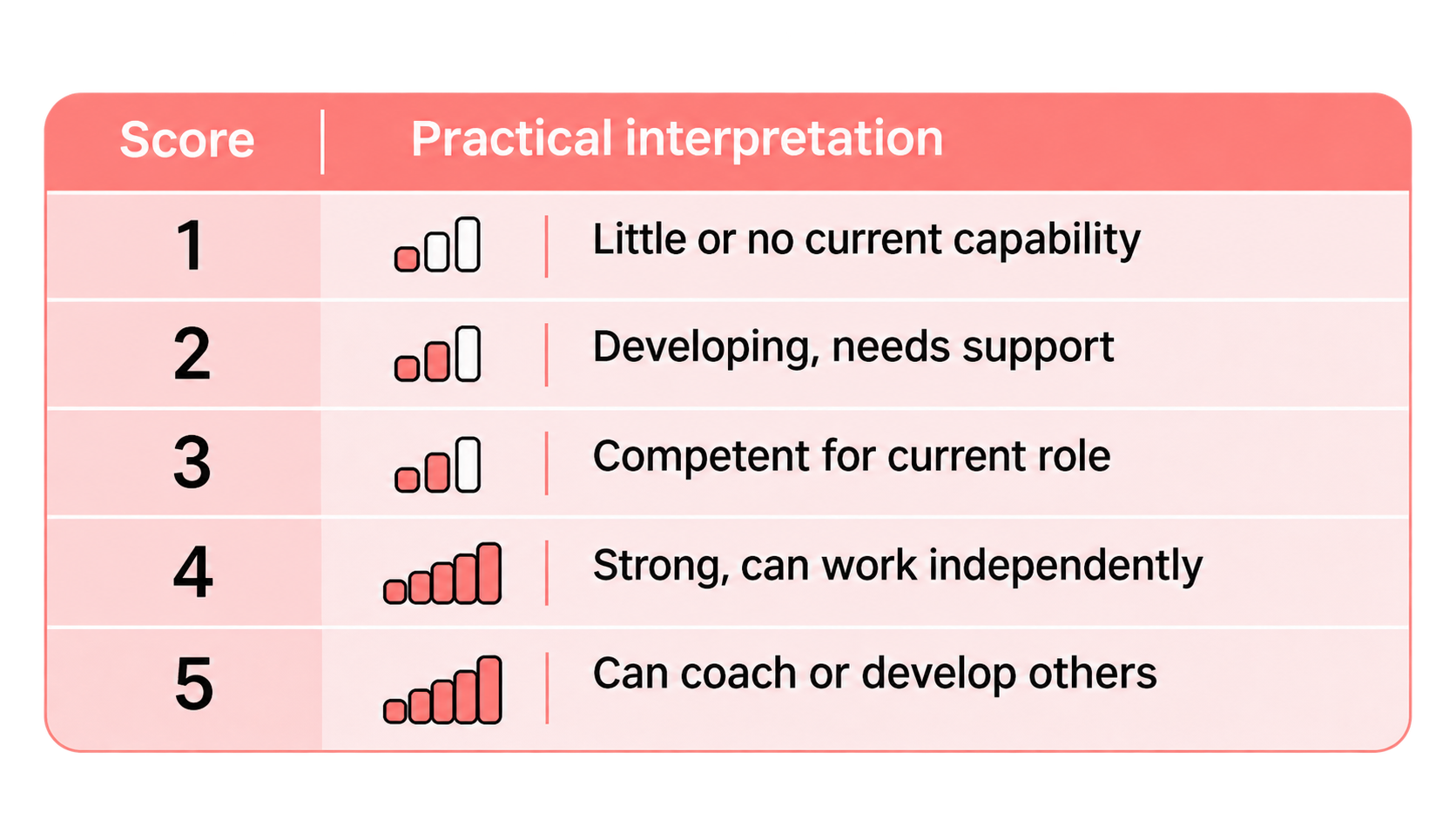
Treat the score as a starting point for a conversation, not a label. Agree the level each role needs: not everyone needs to reach five, and coaching others may not be part of the job. What matters most is the evidence behind the rating. You should be able to explain why a capability has been rated two rather than four, using examples of the work rather than confidence alone.
Bring together observed work, results, manager feedback, employee self-assessment and client data as appropriate. Looking across those sources helps you spot patterns and check your first impressions.
Perhaps eight managers are technically strong, but only two feel confident holding performance conversations. Or the finance team is doing well today, while critical knowledge sits with just one senior colleague. New account managers might understand the service but need more commercial confidence to challenge a client's brief. When the evidence points to manager development, targeted Management Development workshops can focus on the behaviours and conversations that need support.
Each of those situations calls for a different response. Keeping them separate helps you avoid asking one generic programme to meet very different needs.
Case study: NEXT used customer data as part of its diagnosis
There is a useful example from retailer NEXT.
According to Davies Learning Experiences' case study 'NEXT - Enhanced Live Chat Skills' (published 26 January 2022), NEXT's existing Live Chat training had been overtaken by changes in how customers were using the channel, while customer feedback was declining.
Davies began by looking at the work itself, alongside listening to employees. It observed Live Chat teams, reviewed chat logs and existing training content, and held focus groups with managers, trainers and advisers. That evidence helped shape a more advanced skills programme.
Davies reports a 12.66% increase in customer satisfaction scores in the six weeks after training and says its work contributed to a 19% uplift in Live Chat take-up over three months. These are provider-published results, not an independent evaluation, and they don't establish that training alone caused the changes. The useful lesson is how the programme began: with evidence from the actual work.
For a smaller business, the takeaway is straightforward: spend time understanding the work before choosing the learning. You don't need to match the scale of the programme to use that approach.
How do you know whether training is actually the solution?
Finding a gap doesn't automatically mean you need a training course. Before committing your learning budget, take a little time to understand what would genuinely help.
Think about a manager who's falling behind with performance conversations. They might need help with how to hold them, or more confidence to put that knowledge into practice. They may be unsure whether senior leaders will support them, find the process difficult to use, or have 14 direct reports and too little time. The same visible problem can have several different causes.
Some of those needs can be addressed through learning. Others need a change in the way the work is organised or supported.
Ask first whether knowledge, skill or behaviour that can reasonably be developed is at the heart of the gap. Then agree the support that fits. That might include learning or coaching, alongside clearer accountabilities, simpler processes, better tools, role redesign, clearer management expectations or additional resources. Where performance management is appropriate, it needs to sit within a fair, supportive approach, not replace understanding the cause.
Training can be an important part of the answer. It doesn't have to be the whole answer.
Case study: Bupa's learning analysis narrowed the problem
Davies Learning Experiences' case study 'Bupa Increasing Sales Competence' (published 24 November 2021) describes work with Bupa involving 180 healthcare consultants across two UK sites.
The starting brief was to improve sales capability while maintaining compliance. Davies says its full learning needs analysis brought the priorities into sharper focus: confidence, compliance and customer experience. It adapted training to different sales contexts and trained team leaders to keep coaching people after the programme.
Davies reports a 7% increase in new-business conversion in the month after training, retention improvements of up to 10% in the month following full roll-out, and an overall compliance rate maintained above 90%. Here, compliance was measured through internal quality assurance; the figure isn't a legal compliance certification. These are the supplier's own reported results, rather than independent evidence that training alone produced the improvements.
Again, you don't need a programme of this size to take something useful from it. Identify a focused set of needs, build the support around them and involve managers in helping people use what they've learned. That gives the development a clearer purpose than a broad brief to 'improve sales'.
How should a small business prioritise the gaps it finds?
First, check what the business is already required to provide. Health and safety training and any applicable regulatory training requirements need their own place in the plan. A limited budget means making choices about discretionary development; it doesn't remove legal obligations.
You may find more development needs than you can tackle at once. That's understandable, especially in a small business. The next step is to agree where to focus first.
We'd talk through four questions:
Business importance: How much does this capability affect current or future priorities?
Size of gap: How far is current capability from what is required?
Number of people affected: Is this an individual issue or a broader organisational need?
Cost of doing nothing: What happens if the gap remains?
That last question can help put the others into perspective.
Presentation skills might be a useful development goal for a manager who rarely presents externally, without being the most pressing need. If eight managers need support with probation conversations just as you're planning to recruit 30 people, the case for acting sooner is clearer. It's about matching the timing of the support to the work ahead.
CIPD recommends prioritising the most critical gaps in light of the outcomes the organisation needs. For a smaller business, the cost and time involved matter too, alongside any legal or regulatory requirements that must be met.
Aim for a plan you can put into practice, with enough time and support for people to benefit from it.
Case study: the Staffordshire Skills Hub
The British Chambers of Commerce's Workplace Training and Development Commission highlighted a useful SME example in its report 'Report of the British Chambers of Commerce Workplace Training and Development Commission' (May 2021).
The Staffordshire Chambers of Commerce Skills Hub provided smaller businesses with workforce training needs analysis, skills planning and access to suitable training and funding. In its first year, the Hub completed 218 training needs analyses, produced personalised skills action plans and helped develop new training partnerships.
The helpful principle is the connection: learning needs, business growth and workforce planning were considered together, rather than training being treated as a separate task.
It also recognised something small businesses know very well: even when the need is clear, cost and access still matter. The CIPD now makes a similar point in its guidance for smaller organisations, recommending that employers consider costs and benefits alongside funding and resource options when responding to identified skills gaps.
What should come out of a learning needs analysis?
The most useful outcome is a clearer set of decisions, not simply a spreadsheet of red, amber and green ratings. You want to know where to focus and what to do next.
By the end, you want a clear view of:
which capabilities matter most to the business;
where current gaps exist;
what evidence supports that conclusion;
which gaps are organisation-wide, team-based or individual;
which priorities need action first;
whether the answer is learning, coaching or something else;
what success should look like after intervention.
CIPD identifies several useful outputs: an overall learning-needs report, prioritised performance gaps, learning and development plans, personal development plans, and decisions about the right solution. For your business, these can feed into a practical Learning + Development Strategy, connecting development activity, priorities and budgets with your business goals.
Keep the action plan simple enough to use. The table below is an illustrative example, not a client case study. In your own plan, also agree an owner for each action, the budget and time needed, a review date and a starting point against which to judge progress.
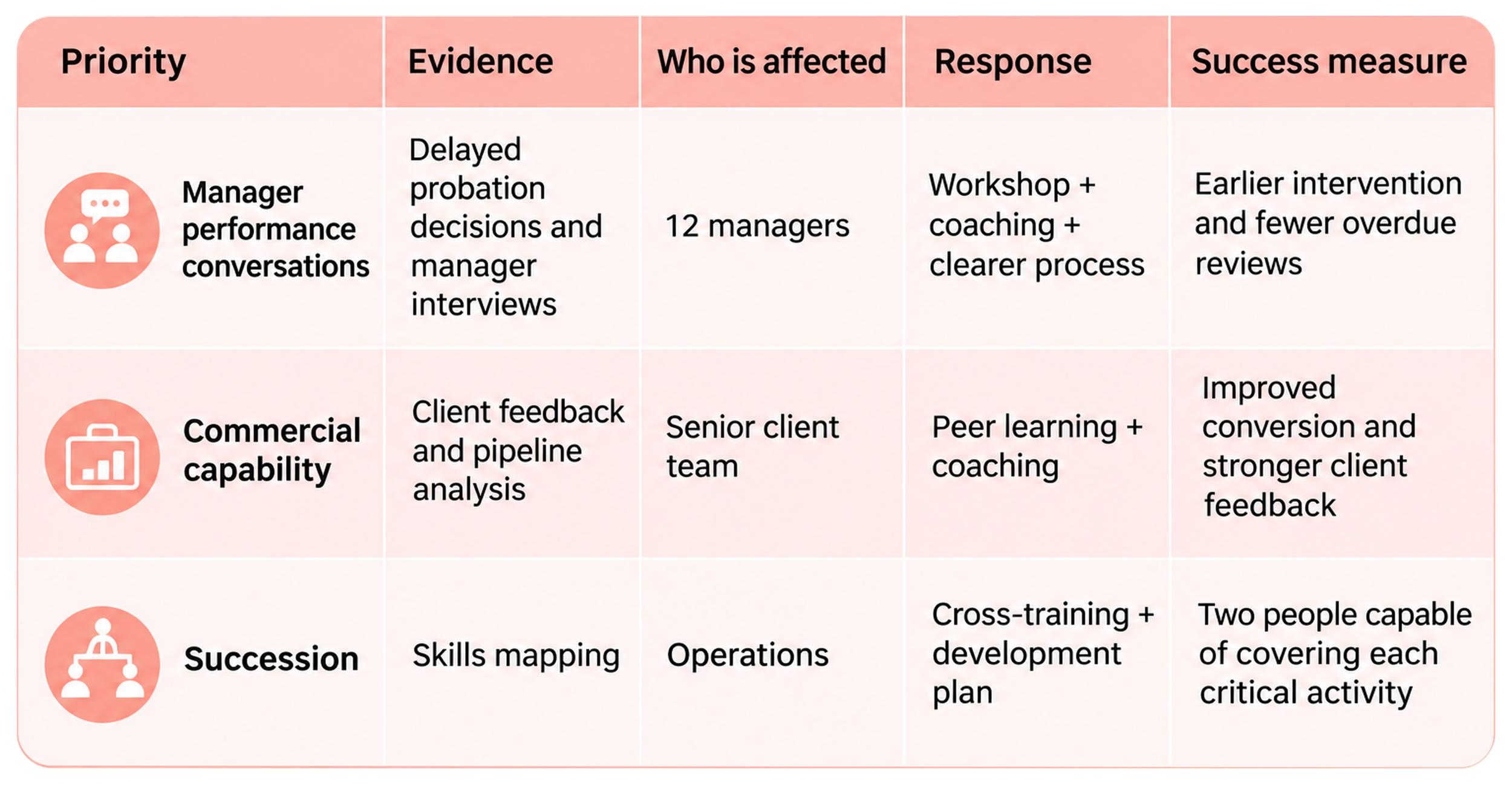
The value is in the decisions the plan helps you make, and the support that follows.
How often should employers review learning needs?
There's no single review date that will suit every business. A useful approach is to build learning conversations into the way you already plan and manage the work.
Keep the picture under review, and take a closer look when something important changes in your business.
CIPD describes LNA as an iterative process: keep talking with stakeholders so learning stays connected to the organisation's changing needs.
For most growing small and medium-sized businesses, we'd suggest three rhythms. Review the broader capability picture annually alongside business and workforce planning. Check in on team and individual development quarterly through your usual conversations. Then revisit the plan when something significant changes, such as a restructure, rapid hiring, a new service or technology, a major promotion round or a change in strategy. These are practical starting points, not a fixed timetable for every business.
Think of the skills map as a working picture, not a permanent record of what people can do. As roles change and people develop, the plan needs to move with them.
How JourneyHR can help
We help you understand the capabilities your business has today, what your people will need as it grows, and where learning is most likely to make a meaningful difference. The starting point is your business and the people doing the work.
From there, the right next step might be a management development programme, a career framework or a clearer view of the capabilities different roles need. Sometimes, the most helpful finding is that something else needs attention before you invest in training.
We want you to feel clear about that choice, rather than under pressure to book a programme.
Our Learning + Development Strategy work starts with your business goals and current capabilities. We then help you build a plan to close the gaps that matter most. Depending on what you need, that could involve workshops, coaching, mentoring, external providers or other ways to develop your people.
When training is the right fit, we design workshops around the situations your managers and teams are dealing with, rather than starting with a standard catalogue. People have opportunities to practise and receive feedback, helping them move from understanding an idea to using it in a real conversation or task.
If your business is growing and you're not sure where your learning budget will make the biggest difference, we'd love to talk. Let's explore what your people need before you commit to a programme.
Get in touch: JourneyHR contact page
Final thought
A useful learning needs analysis gives you space to pause before choosing the solution.
Training requests and conversations about what people would like to learn are valuable starting points. They're the beginning of the picture, rather than the whole of it.
Bring those conversations together with your business plans and performance evidence. Where do they tell the same story, and where is there something you need to understand better?
The next step might be training. It might also be clearer roles, a better-supported manager, a simpler process or more help with the work.
Understanding that first helps you invest with more confidence, and gives your people support that fits.
FAQs
How do you run a learning needs analysis for a small business?
Start with what your business is trying to achieve and what people will need to do well to get there. Compare that with the picture today, drawing on business data, manager insight, employee conversations, observation and role information. Agree the most important gaps, then explore which need learning and which have another cause. The aim is a practical plan for support, not simply a list of courses.
What data should a training needs analysis use?
Bring together several sources, rather than relying on employee surveys alone. Performance figures, client feedback, appraisal information, manager interviews, employee conversations, observation, role descriptions, competency or career frameworks, learning data and future business plans can all help. CIPD recommends combining sources because each gives only part of the picture. Use personal information only where it's needed and with the appropriate data-protection safeguards.
What is the difference between learning needs analysis and training needs analysis?
The main difference is the scope. A training needs analysis usually focuses on a particular training requirement for a person, team or activity. A learning needs analysis takes a broader, ongoing view of the capabilities your business needs now and next. It explores why gaps exist and whether formal training is the right response, rather than assuming a course is the answer.
How do you identify skills gaps across a team?
Agree what good performance looks like for the work, then compare it with evidence of what the team can do today. Bring several sources together rather than relying entirely on self-ratings, and give people a chance to share their experience. A score can help start the conversation, but the useful outcome is understanding which capabilities need support, why they matter and what evidence points to the gap.
How often should employers review learning needs?
Keep learning needs under review through regular conversations, rather than leaving them for an annual exercise. A fuller review can sit alongside annual business planning, with check-ins on team and individual needs during the year. Take another look when strategy, technology, structure, roles or workforce requirements change. The rhythm needs to fit your business and any applicable legal or regulatory requirements.
